Wednesday, March 20, 2013

Catch Cachette!

The last few days leading up to this, the first day of Spring, have been remarkable. Sustained snow fall punctuated by wonderful periods of sunshine - a real mixture of winter and spring weather. The result is a good 45-60 cm of fresh snow everywhere (but slightly heavy lower down), totally re-invigorating the mountain and those who skiing on it! Let's hope it all lasts through the UK Easter holidays, which start on Saturday.

Not yet a cinema, after 4 years of wrangling....
More bad news in the local paper today about the failed multi-screen cinema complex, next to the Coeur d'Or building in Bourg (opposite Intermarché). It was built 4 years ago by the Coeur d'Or developers, MGM, with a grant of €1.7 million from the town. But it never opened as there has been a long-running dispute between the town and Cinéalps, who were supposed to operate the multiplex. They agreed to spend €1.3 million on fitting it out (at the moment it's just a concrete shell) but they either didn't have the money or didn't want to spend it. The latest stage of the row is over the acoustic insulation, which should have been installed during the main build but was somehow left out! The town has agreed to pay for this (a mere €170,000 euros) if Cinéalps  honour their committment to the scheme, but now Cinéalps want the town to pay them €300,000 euros to finish it! What a mess; it's difficult not to feel rather sorry for Mde Peretti (the mayor) as her pet projects fall apart one by one (CNSHN, Quartier Bulle, cinema....).

The only tangible benefit I can see from the failure of the CNSHN project  is that the 'mythical' Cachette piste and lift at Arc 1600 will continue to be available to everyone as well as being used for competitions and training.

The old Charmettes drag, where Cachette is now.
The Cachette piste existed before Les Arcs. Courbaton 1750, the small network of lifts built by the commune of Bourg St Maurice from 1961, culminated in a several long drag lifts starting from near the Beguin Hotel. One of these ascended to the 'plateau de l'Arpette', more or less where the top of today's Cachette lift is  (2170m) .  From there one could ski the trace of the Cachette piste all the way to Les Granges and, with any luck, all the way down to Bourg (nearly 1500m vertical).  In 1967 a new lift called Cachette was built from where the bottom of Combettes is now (near the Arc 1600 ski school) to where the eponymous lift ends now, and a shorter drag lift called Charmettes was erected where the Cachette lift is today (you can still see the trace of it the trees to the left).

Looking up at the Cachette lift...
During the next 20 years various additions, doublings and upgradings took place (and even more very confusing name changes!), until in 1989 the Cachette high-speed (it was then) de-clutchable lift was constructed, the resorts first modern chairlift.  It can uplift 2500 people an hour, in just over 5 minutes, and until the new Mont Blanc lift was built in 2010/11, was the most heavily used lift in Les Arcs. It was opened at the same time as the funicular, to cope with the increasing numbers of local people and tourists coming up from Bourg.  Before the CNSHN project came along (and went away) there was talk of upgrading it, but suspect with the new Mont Blanc lift next to it that will never happen.

'Le Mur de Cachette' can pose some difficulties, even to the Ski Club!
The Cachette piste, described as 'mythical' by the mountain bike fraternity who get to enjoy it in the Summer (used for World class DH competitions), is the only piste in Les Arcs homologated by the FFS (French Ski Federation) and FIS (international) for world-class Slalom events. To this end, it has the resorts densest snow-making coverage, with over 40,000 m3 being pumped on to it at the start of the season to ensure a good, hard base for the the events that generally take place at the end of the season, such as FIS Men's Slalom race on 1st and 2nd April. If the CNSHN project had gone ahead snowmaking would have increased to 56,000 m3, at an annual cost to the resort of nearly €200,000 euros, so that saves a bit of CO2 output as well as money.

The piste is 1740m long and 45m wide, and the steepest bit (know as the often icy 'Cachette Wall') is 29 degrees (averaging 19 degrees). The name, which was taken from the small group of chalets and barns still in evidence above Arc 1600 means 'hiding place', but is probably a corruption of the Savoyarde dialect word 'cochette', meaning small col or pass. Cachette gains a mention in Claudie Blanc's moving account of the last day of her  father Robert Blanc's life*  (4th February 1980), when his brother Yvon rushes up to pisteurs' hut at the top to get a team together to search the road to Arc 2000 for a possible avalanched car and its occupants. It is while returning from this fruitless search that Robert was killed outright by an avalanche near Pré St Esprit.

The putative CNSHN tunnel plan for Cachette
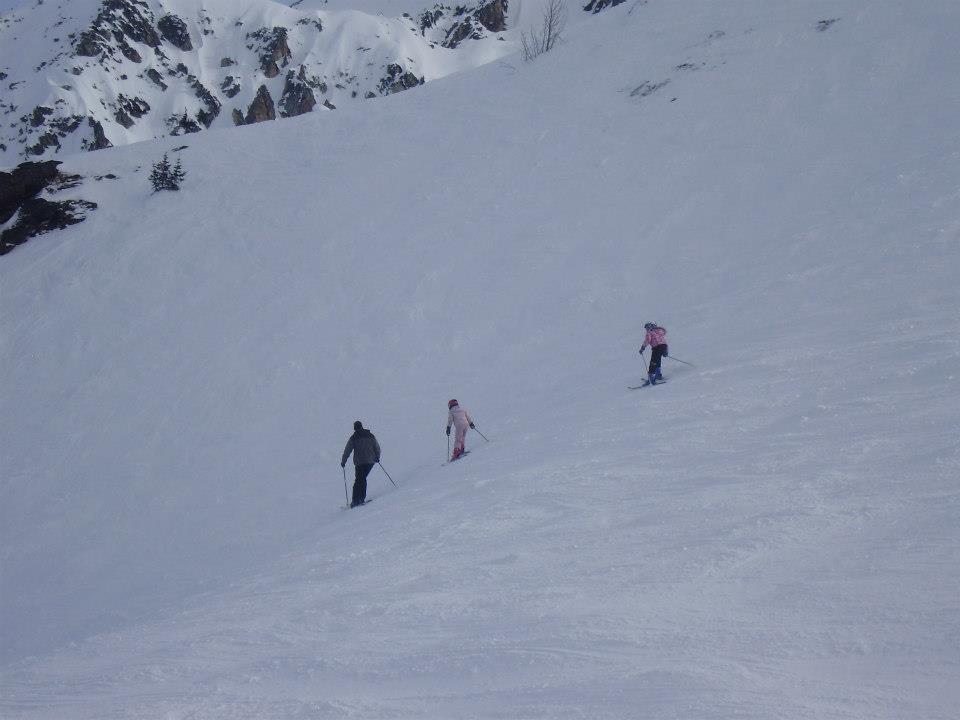
Cachette is appropriately classed as a red run for us skiing punters, but I think it's a challenging piste to ski perfectly from top to bottom, fast but with style (remember all those people watching you as they come up the lift!) because of the subtly varying camber and pitch, and of course the hapless blue-run users who cross it on two occasions (perhaps the CNSHN tunnels weren't a bad idea after all!).  But there no better piste skiing, first thing in the morning after a nice dump of powder, when its normally deserted. Try it sometime, top to bottom with no stops. Breathtaking!

The Cachette piste also makes Arc1600 the best place to be at the end of a poor snow-season: all that artificial snow means it doesn't really melt until June...
========================================================================
* From the first chapter of  Reve de Bergers, by Claudie Blanc-Eberhart (I have started translating it,contact me for more details) http://www.decitre.fr/livres/reve-de-bergers-9782907984324.html

Links:

http://www.espace-arcadien.fr/r1600cachette.html

http://montagne-cable.legtux.org/reportages/reportage-tsd4-cachette
http://www.remontees-mecaniques.net/bdd/reportage-38.html
http://www.fichier-pdf.fr/2013/03/16/visite-piste-dediee-cachette-ffs-sma-cnshn/preview/


Saturday, March 16, 2013

Flagship CNSHN 'ski academy' project cancelled

It came as a bit of a surprise, but the writing's been on the wall for a while now. The towns flagship project, the Centre for National High Level Ski Studies has been abandoned.

Quartier Bulle barracks - white elephant?
The FFS (French Ski Federation) announced on Thursday that they were cancelling the project as there wasn't enough support or commitment from the various organisations involved (coded words for 'we couldn't get the money together').  This is a major blow to the future of Bourg St Maurice, as it was hoped the centre would generate up to 100 new jobs and possibly €4 million of extra income. The old army barracks, the Quartier Bulle, is one step closer to becoming an expensive white elephant, as this was to be the base for the CNSHN and related sporting  and leisure activities.

So why did it all unravel? Here's a short history of the doomed project:

  • In 2001 the French Government passed a bill aiming to set up a number of poles for 'High Level Sport Training',  to improve the country's Olympic prospects and to encourage wider sports participation (France too has an increasing couch-potato problem).

    FFS officials and local dignitaries visit Cachette in 2010
  • In response, in 2007 the FFS said there was a need for a centre for young people (of secondary school age) who were talented at skiing to train to become future world class athletes. Apart from improving France's ranking in World Class skiing, there would be spin-off benefits to the sport as a whole and the community which would host it.  Several locations in the French Alps were considered, including Chamonix and Albertville (which is now looking like a possible alternative location). The centre would cater for 110 athletes.
  • In 2009 Bourg St Maurice was chosen as the location for the new centre, on the basis of being close to many major ski resorts, having the FFS-homologated Cachette piste which would be reserved for training and competitions (with new tunnels under it for hapless tourists wanting to get back to Arc 1600!) and the vacant Renouveau holiday centre, which was then viewed as an ideal base for the project.

    The project was going to cost €6 million euros, and as the full effects of the credit crunch had yet to be felt no one thought there would be any problem raising the money. The centre would open in 2012/13, just after the final departure of the 7BCA army regiment from the Quartier Bulle barracks.

Damien Perry - forced to resign

  • However in 2010 a massive argument broke at at the Conseil Municipal (local council) when is was discovered the true cost of the project would be  €14m euros! A third of the councillors resigned, forcing the mayor himself, ex-pisteur Damien Perry, to resign in April 2011. There were subsequent council and mayoral elections, with Mde Jacqueline Poletti returning as mayor (she had previously held the office during the 1980s) - she was largely seen as a safe pair of hands in a time of crisis.

    The project was revived, and support was sought from the regional authorities. It was decided later that year to house the CNSHN in the newly vacated barracks, rather than on the crumbling Renoveau site, which in itself was going to cost €4m to adapt and renovate.

    Crumbling - derelict Renoveau holiday camp
  • In 2012 the town received compensation for the departure of the 7BCA (which led to a reduction of the  population by about 1200 and the loss of up to 300 jobs), of which €1m was dedicated to the CNSHN project. But there were still serious doubts about where the rest of the money would come from, and town council started to worry that the they couldn't afford it (it was estimated that the running costs would be over €2m a year).


  • The biggest nail in the coffin, however, was a big row last year about paying for the normal education requirements of the (now only 94) student athletes. Setting up new school facilities in the Quartier Bulle was going to be expensive, and the students would be isolated from their local peers. So  it was strongly suggested by the regional authorities that the students the could actually live (as well as study) in the 'Cité Mixte' (grouping of local schools on a new site developed a few years ago), leaving the role of the old Barracks site rather in question...  The town wasn't happy with the proposal, which was seen by the FFS as a dimming of their support for the whole project.


With so many unanswered questions and potential problems, it seems hardly surprising to anyone (except Mde Peretti, apparently) that the FFS would call time on the project, as least as far as Bourg St Maurice goes.

Cachette piste at Arc 1600
Once again the town is staring into a financial and political abyss, but it's not for the first time. The rise and fall of the Hydro-electric development in the 1950s left the town in a similar position. It was saved by the Les Arcs project. The recessions of the 1970s and 1980s hit the town (newly reliant on ski tourism) hard, but it survived, flourished even. Now there's new, and harder challenge: to find something to buoy the future that doesn't rely on the slowly diminishing ski industry, that is sustainable and makes sensible use of the town's increasing catalogue of disused real-estate.

    But at least the wonderful Cachette piste at Arc 1600 is still their for all to enjoy, and the new Mont Blanc lift is a legacy of CNSHN fiasco.
    =======================================================================

    Links (in french):


    Friday, March 8, 2013

    Our local Beaufort cheese wins a medal!


    Beaufort cheese has won a silver medal at the Paris 'Concours Generale d'Agriculture' (a bit like the now defunct British Royal agricultural show) . Actually, the cheese won gold medals at the last two concours, but for obscure reasons gold wasn't awarded this year.

    Beaufort: 400 ltrs of milk = 40kg cheese
    Apart from being delicious to eat and having a wonderful smell, the success (and even the existence) of Beaufort is linked inextricably with the development of the skiing industry in Savoie, and in particular in our valley, the Haute Tarentaise.  It really is our 'local' cheese, as it's made here in Bourg St Maurice, and elsewhere in Savoie.

    Cheese making in the Alps was born from the necessity to conserve the nutritional qualities of abundant summer milk in order to survive the long hungry month of winters. In the middle ages various monastic orders descended on Savoie with the aim of improving the lot of the starving peasants, and introduced major improvements in the management of cattle and the terrain on which they grazed. Thousands of acres of mountainside were cleared of  undergrowth and scrub to create large, communal pastures.

    The system of 'alpage' began, where cattle were grazed progressively higher and higher up the mountains as the snow melted and the summer arrived. By October, and the end of the '100 days of alpage' the cows could be up at 2000 meters, before they were ceremoniously herded back to the valley villages on the festival of 'La Demontagne', all of which still goes on today.

    Trifolium - vital to the cow's diet
    The cattle's owners travelled with them, having constructed rustic 'chalets' at different altitudes in which they could live while guarding and milking the cows, and in which they made cheese from the wonderful fresh milk drawn from happy cows feeding on the 250 species of plants found in the alpine pastures. Centuries later it was these chalets (unused by their owners in the winter) that were rented by the English alpinists in the 1930s as bases for their early skiing exploits.

    The name 'Beaufort' started to be used for the cheese, which is technically a kind of gruyere but without the holes, in the 19th century, as a great deal was produced on the massif de Beaufortain (the range of mountains which you look at across the valley from Les Arcs).  Production grew to over 10,000 tons a year, and in 1939 a co-operative was formed to store, distribute and market the cheese more widely. However, the ravages of the war, subsequent economic decline and mass exodus from the Alps to the cities led to a rapid decline in this kind of agriculture and by 1960 only 500 tons a year were being made.

    After the war France needed electricity more than cheese, and the various huge hydro-electric projects across Savoie (I've written about the Tignes-Malgovert scheme in an earlier blog...) brought people and money back into the valley, at least for a decade or so, until these schemes were finished and the money and people departed. Many local communes, including Bourg St Maurice, looked to the burgeoning winter sports industry for salvation, encouraged by the governments heavily-funded Plan Neige of 1964. Once again, money and people with an appetite for local produce started to flow back in, and a group of farmers in the Tarentaise got together to form a new Beaufort co-operative. The cheese received its 'Appelation Controlée' status in 1964, and production and quality have increased ever since.

    Daily turning and washing
    Beaufort is quite complicated to make - it takes 400 litres of milk (only from Tarine or Abondance cows) to make a 40kg cheese. The milk is heated in large copper pans until it separates, then drained, cooled and pressed into circular beechwood moulds. During the maturing stage the cheese is turned daily and brushed with salt water to create its distinctive hard orange casing which keeps the flavour in as it develops for up to 12 months in the 'cave d'affinage'. Labour intensive, so it's one of France's most expensive cheeses, although the Savoie milk producers protest that they are among France's worst paid dairy farmers.
    Tarine cow

    The production cycle of Beaufort fits well with the 'seasonality' of the skiing industry: the cattle keep the pastures nice and short so that when they become pistes in the winter the early snow holds well (long grass crushed under the weight of snow can be a significant avalanche risk at low altitudes).

    The summer grade of the cheese (Beaufort d'été), the best, is perfect for winter fondues, and the cattle over-wintering in the valley sheds and barns mostly feed their milk to their calves, reducing the manpower needed for milking, etc.and freeing up labour for winter resort-related employment. And of course, the massive influx of winter tourists provide a wealthy and willing market for Beaufort and other local cheeses.

    Many people criticise the environmental impact of the winter sports industry, often with some justification. But  Savoie is not just a landscape, it's also a community with it's proud  traditions, expertise and customs that are worth keeping alive. There's no doubt that without the ski business Beaufort cheese, and many other good Savoyard things, would no longer exist. So make sure you eat some today, and tell your friends. It really is wonderful stuff!

    ======================================================================
    You can visit the Bourg St Maurice dairy co-operative any Friday morning for a guided tour and see Beaufort being made. See http://www.fromagebeaufort.fr/cooperative-laitiere/bourg-st-maurice for details.

    Tuesday, March 5, 2013

    Ski Guiding: it's had its day, in court.

    Skiing with my daughters in Arc 1600 
    My blog-writing career seems to have been brutally interrupted by a mixture of illness (the dreaded 'Grippe' which seems to have most of France in its grip..) and the school holidays: 10 highly enjoyable days of skiing with my children in the near-perfect conditions at Les Arcs.

    So now it's shoulder to the word-processor wheel again, and I can't resist having my say about the 'Ski Guiding' controversy which came to a head on 19th February when the court in Albertville upheld a judgement against a British tour operator in Meribel who had been illegally employing unqualified people to act as 'ski guides' for their clients.

    Most aspects of French life are regulated by a set of 'Codes', which set down all the legislation relating to a certain area, such as 'Commerce', 'Route' (roads), 'Travail' (work) and in this case the 'Code du Sport', which governs the organisation, teaching and funding of sporting activities of all types, including skiing.  A complaint was made against  the tour operator 'Le Ski' in relation to Article L212-1, which relates to remuneration:
    Seuls peuvent, contre rémunération, enseigner, animer ou encadrer une activité physique ou sportive ou entraîner ses pratiquants, à titre d'occupation principale ou secondaire, de façon habituelle, saisonnière ou occasionnelle.... les titulaires d'un diplôme, titre à finalité professionnelle ou certificat de qualification.
    My translation:   Only those with a a diploma, professional title or certificate of qualification may, for payment, teach, organise, lead or train participants in a physical or sporting activity, whether this is a full or part-time, regular, seasonal or occasional occupation.


    This part of the Code applies to all kinds of sports, including skiing and snowboarding, so all this fuss could just as well have been about hockey or football.  A lot of the debate at the court centred around the definition of guiding ('accompagnateur'), but the key factor seems to have been that Le Ski's people were being paid specifically to do this, which is therefore illegal.  The court also noted the these ski guides were being remunerated at below the legal minimum wage, and most of the fine imposed was actually in relation to that offence.

    I know from my own extensive ski guiding experience that as soon as you get a group of people together and give them any kind of instructions you inevitably have responsibility for the outcome of following those instructions, so it seems highly reasonable to me that 'ski guiding' falls within the scope of the Article L212. Mention was made during the hearing, by the prosecution, that the mountain is a specific kind of environment requiring specific knowledge and understanding of its dangers and risks.  Who can argue with that?


    I think the comments of  certain other tour operators after the judgement that their ski guides 'never take people on black runs or go off piste, they stay mainly on blue runs'  largely vindicates the correctness of the reasoning behind the judgement; the 'specific mountain environment' isn't defined by piste colour, and in any case there are far, far more accidents, fatalities and injuries on blue pistes then anywhere else on the mountain.


    The controversy about ski guiding has been rumbling on for years, especially at Meribel, where I remember this being an issue when I worked there, as a ski guide, in the 1980s.  There were apocryphal stories of ESF instructors (I wondered how long I could write this for without mentioning them!) breaking the skis, poles and even legs of illegal ski guides and unqualified instructors and tales of armed squads of skiing gendarmes making mass arrests of ski bums trying to earn a pint and a plate of chips showing people the then new art of snow-boarding... 

    Valmorel - under-rated gem of a resort

    At around the same time, there was a terrible incident at Valmorel where a Dutch ski guide managed to get her entire group trapped in a closed mountain restaurant in a blizzard, entailing a dangerous rescue that lasted 2 days and included two pisteurs being seriously injured when their snow-mobile overturned in appalling conditions. Things can go badly wrong for ski guides: she and her employers were later taken to court and had to pay a substantial fine.

    I imagine in Meribel, as elsewhere, the annoyance of the ESF and other professional ski schools has intensified greatly since 2008 when all tour operators, etc. found that with the collapse of the value of the pound guests were far less likely to shell out on ski school - in my business I have  seen a fall of about 80% in the numbers booking any kind of ski lessons. With the 'chalet holiday' market under pressure, offering 'ski guiding' seems like an easy and relatively cheap way to 'add value' to the product and maybe increase client fidelity.  Much of the ski guiding offered by tour and chalet operators is actually pretty atrocious - hung-over 19 year olds with 6 weeks skiing behind them and a scant knowledge of the lift, pistes or 'specific mountain environment' seems to be the norm, according to my guests.
    Early days of ski guiding


    But perhaps behind all this controversy lies a deeper clash of cultures: The British arrived in the Alps between the wars with their characteristic enthusiasm, 'gung-ho' mentality, love of amateurism and suspicion of 'foreigners'. These qualities are still reflected in the products of British tour operators, with their 'dinner party' (normally cooked by amateurs) atmosphere and afternoon tea, all provided within an English bubble avoiding any contact with the locals or the dreaded French language. Many of these tour and chalet operators were set up by enthusiastic amateur skiers looking for a life-style change ( and I count myself among these) with the creditable aim of sharing their love and enjoyment of the mountains with others of the same ilk. 
    Jean Claude Killy - Plan Neige pioneer

     On the other hand, since the 'Plan Neige' of 1964 France sought to enlarge, develop and professionalise its skiing industry through funding, training schemes and investment tax breaks. In order to do anything in France you need to call yourself a 'professional' and do some kind of course or get some kind of diploma (even washing up in a kitchen or serving in a shop). The local communties of the Alps have been saved from extinction by the success of the Plan Neige - up until then there was mass exodus to the cities, stemmed by the new opportunities generated by the ski business. People who were once farmers or foresters retrained as pisteurs and instructors. At the same time government poured money into infrastructure developments and the result we have before us: the greatest ski areas in the world co-existing with the unique wild environment of the Alps which largely owes its conservation to that ski industry.


     There's much talk about 'respecting the mountain' these days, and surely this implies respecting the local  mountain communities who earn their livings as ski industry professionals and in related activities.

    Les Arcs app
    The time has come, it seems to me, for everyone to look hard at the products and services they are offering, whether this is the ESF (who, although I respect them greatly, certainly need to adopt a more flexible approach to how they offer the teaching and guiding  services that they can do so incredibly well), the tour and chalet operators and the resorts themselves. 

     The British are becoming a smaller and smaller part of the market; the future lies in the new clientele from the emerging economies of Russia, China, India, etc. In preparing for this many resorts have already done a great deal to improve maps, signage and offer navigatoinal 'apps', helping people to discover the ski area themselves. In Les Arcs the resort itself offers free 'ski guiding' orientation every week, provided by a professional English-speaking guide.

    British chalet guests - threatened species?
    I don't think anyone is saying the informal or social skiing (e.g. by a chalet owner) is illegal or undesirable, and such people are much more likely to have the local knowledge, anecdotes and experience necessary to enhance their guests enjoyment rather than an under-trained and poorly paid teenage ski guide. 

    Tour operators could improve their  staff training in local knowledge and advice for guests, as well as encouraging them to take advantage of the professional services available in the resort (and the ESF are not the only instructors or guides around). Negotiation, persuasion and understanding could go along way to establishing sustainable alternatives to the peculiarly British ski guide system, which lets face it has finally had its day - in court.

    Thursday, February 14, 2013

    Good news for Les Arcs - new projects approved

    Despite the doom and gloom emanating from Bourg St Maurice and Mde Le Maire in the last few weeks, I was surprised and delighted that on Monday the conseil municipal passed a provisional budget for 2013 which includes several goodies for Les Arcs.

    There has been much wrangling recently as to whether the town should be trying to pay down its €40 million debt, with the possible effects of improving their credit rating for future projects, or if investment now in more modest projects is the way forward.  Well, thankfully anti-austerity common-sense has ruled the day, and €8.5 millions euros are on the table. This is how it's going to be spent:

    Arc 2000 - to be transformed
    1) Improvements to Arc 2000. A new building is going to be constructed near where the buses stop (presently a horrible shabby and unwelcoming first impression for new arrivals)  with a new tourist office, baggage store (hopefully to encourage late Saturday departures to get and extra day's lift pass...), a waiting room with nice toilets. The old 1970's 'Dynotron' lift will be replaced and enlarged. This is all going to cost €1.4 million. It extremely pleasing to this happening at Arc 2000, which ought to be the 'jewel in the crown' of Les Arcs rather than a negelcted backwater.

    Tatty funi footbridge
    2) Renovation of the Funicular footbridge at Bourg St Maurice. About time too - I'm sure a lot of people must step off the train and seeing that scruffy monstrosity feel like getting straight back on and back to Paris or wherever! Anyhow, it's all going to be re-done, new floor, walls and 2 new lifts up from the Funi terminus.There will new digital information displays and new lighting throughout. There is also talk of a possible extension of the paserelle up to the old 7 BCA barracks site - great idea, but it would mean more then doubling its length and passing though various private gardens and Lidl! Perhaps it would  be best to wait and see if anything ever comes of the redevelopment plans for Quartier Bulle.... Budget: €1.9 million

    I do hope they manage to restore the striking triangular neon sculpture thing (hasn't worked for years) above the main staircase.

    The existing swimming pool will be the
    basis of the Centre Aqualudique
    3) €850,000 has been voted for initial studies and planning for the proposed Centre Aqualudique at Arc 1800. This project would include swimming pools, spas, water splashes etc (anyone else seen the fantastic one at Morzine?) which would truly be a great asset to Les Arcs summer offering. The whole thing is budgeted at about €6 m, which they hope to raise by selling the old Renoveau Holiday camp (how many times over has that money been spent I wonder?). So no real certainties there for the moment, but at least a start has been made.

    There is also going to be a major refurbishment of the town's Nursery (Le Pomme d'Api) and the creation of a permanent travellers' site (this should benefit winter seasonaires). There is also money for the cemetery, sewage, car parks, buses and water mains.

    It also transpires from the municipal budget that €2.8 million is going to towards lift investments - I assume that will cover the Chantel replacement and the new rope-tow on the 'snow front' at Arc 1800/Villards (to compensate for another of the "5 great planning errors of Les Arcs" - blog coming soon!)

    Daniel Payot - against the budget
    So where is this money going to come from? It appears the sale of the Old Gendarmerie, which bought in €2 million, and some building plots at Courbaton for another million are the main sources. Other than that it's coming out of the towns revenue and from savings and cost-cutting.  The conseil municipal opposition, led by Daniel Payot, argued against the budget saying that it was dangerous to sell the town's assets now as in a few years time the town could find itself with more debts and running costs and nothing left to sell.

    There is no mention in the budget of the CNSHN (Centre for High Level Ski Studies) which appears once again to be quagmired by political and financial indecison.  From the extravagant plan to redevelop (and even extend) the Quartier Bulle at a cost of about € 6 million the scheme has been reduced to a proposal to house the 90 potential students in the exisiting 'Cité Scolaire' and for them to use existing facilities left behind by the army (gym, canteen etc). And this was to be the grandiose project that was going to change Bourg's fortunes for evermore....

    Anyhow, let's be thankful for the conseils municipal's sensible approach to this handful of schemes that will make quite a difference to the town and the resort.


    Wednesday, February 6, 2013

    Mont Blanc deaths revive tragic memories of 1957

    Les Droites, Mont Blanc
    My chalet guests often ask me to point out Mont Blanc (4810m), which you can see clearly from most of the Les Arcs ski area. I explain: you are looking at the Italian side, and it's actually only 15km away as the crow flies.

    However, last Sunday as I was once again gazing at the rounded dome of Europe's highest mountain  I couldn't help thinking of the tragic plight of the two Lithuanian climbers trapped on the rocky north face of Les Droites, below the peak at 3900m.

    They had sent a text message on Friday saying that one had tried to set off on skis back to Chamonix and the other was managing to "keep warm in his bivouac using his gas stove". Several attempts were made over the next 48 hours to reach the climbers by helicopter, but with high winds and  heavy snowfall  they were unable to get lower than 4300m, or closer than 300m to the stricken pair.  Finally, on Sunday afternoon a helicopter with heat-seeking equipment was able to ascertain that they were both dead, the one who set off on skis having fallen in the Lagarde couloir. Their bodies will be recuperated when the weather permits.

    The local paper mentions a similar tragedy that befell two British climbers in 1999. One was eventually brought out alive after being heroically rescued on the end of a winch line,  lowered several hundred meters from a helicopter in atrocious conditions (apparently the wind was blowing the snow vertically up the mountain and high above it). This surviving climber lost both feet and hands through frostbite.

    Vincendon and Henry
    However, I was reminded of the extraordinary drama that took place on the Brenva Glacier (south side of Mont Blanc, visible from the ski area of Brévent, above Chamonix), some 57 years ago. The appalling failure of various attempts to rescue the climbers Jean Vincendon and François Henry (both in there early 20s)  led to structural changes in the way that mountain rescue in France is carried out. 

    On 22nd December 1956 the two men, experienced winter climbers, set out from the Torino refuge to climb the Brenva. By chance they came across the celebrated Italian mountaineer Walter Bonnatti and his climbing partner, who encouraged the two young men in their planned ascent. The four climbers slept at the Fourche refuge and setting off in different directions early the following morning. However, soon the Bonatti cordée found conditions worsening and decided to change their plans and to rejoin the others on the Brenva route. By the time they met up the weather was considerably worse and the four climbers had to spend that Christmas night in improvised snow holes. The following day they decided to head for the safety of the Vallot Observatory refuge. Vincendon and Henry fell behind and the groups became separated; they never made it to the refuge.  

    Down in Chamonix friends and associates of the climbers were getting worried (no mobile phones in those days). The Chamonix Mountain rescue service arranged for Sikorsky helicopter to overfly the area. The crew spotted Vincendon and Henry. They were unable to land but they did drop parcels of food and blankets (in fact their fingers were already so badly frostbitten they were unable to undo the knots of the string around these packages).   

    Having established they were alive another rescue mission was launched, using one of the biggest Sikorski helicopters possessed by the French army (known as 'The Elephant') to drop a rescue team close to the the two young men.They would then assist them to the Vallot refuge, which was only 400m away. 


    The crashed Sikorsky S-55, "The Elephant"
    Incredibly, the helicopter crashed, the snow and wind proving too much the for The Elephant, but even more unbelievably none of the four occupants of the aircraft were injured. Seeing the extremely poor condition Vincendon and Henry were now in, the senior rescuer, Commander Legall, had to take a tough desicion; the two helicopter pilots being only lightly equipped were in danger. He decided to place Vincendon and Henry in the crashed carcass of the helicopter, to give them a bit of shelter, and to get the pilots to the Vallot refuge as quickly as possible. He would then return with his colleague to rescue the climbers.

    The climb to the refuge with the inexperienced pilots took a long time. One fell in to a crevasse and it took an hour and a half to get him out. By the time the party reach Vallot they were exhausted and it was nearly dark. There was no question of Legall returning to the men in the wreck of The Elephant. 

    The following day, 1st January 1957 saw a further worsening of the weather and no further rescue attempts on the mountain or from the ground could be attempted. It was only on 3rd January, after mounting media interest and government pressure that two state-of-the-art, lightweight Aloutte helicopters were able to land near the refuge and rescue Legall and his party (why hadn''t they been used earlier?). One Aloutte overflew the wreck of the Elephant, and saw no sign of life from Vincendon and Henry. 

    In Chamonix Vincendon's father, himself an experienced mountaineer, pleaded with the authorities to abandon the rescue in order not to risk further loss of life.  It was not until 20th March that Vincendon and Henry's bodies we able to be brought down, by a team of 28 guides. A chilling epilogue to the drama was that Henry's body was found outside the wreck of the helicopter, probably indicating that we was still alive when the Aloutte flew over them.

    There were huge repercussions, in the press and among the different groups of guides, rescue services, police and military about how such missions should be organised and who should have responsibility for the difficult decisions that have to be taken. As a result the Pelotons de Gendarmerie de Haute Montagne was founded , based on integrated military mountain rescue systems established in the Soviet Union.

    However, even the best resources and organisation isn't always enough to save lives on the mountains, their power being perhaps greater then human  endeavour. 

    There is an excellent, detailed account of the Vincendon and Henri tragedy in PisteHors.com, http://pistehors.com/backcountry/wiki/Avalanches/Vincendon-And-Henry

    Our thoughts are with the friends and families of the two Lithuanian men who perished last weekend.


    Sunday, February 3, 2013

    Plenty of snow in Les Arcs - another disastrous season?

    Last week, outside the chalet
    It's not been a bad winter so far in Les Arcs. Regular falls of snow and relatively low temperatures have resulted in some of the best top-to-bottom conditions I have seen here in the last decade. Even a day of heavy rain at the end of last week was followed by another 10cm of snow that same night, further consolidating the snowpack in preparation for the substantial snow showers forecast for the next few days. The lifts and pistes of Paradiski have been  pretty well 100% open since December.

    Les Arcs and the other large, high-level ski resorts of the Alps, will be hoping for a big thaw, rise in temperatures and closure of low-lying pistes and  lifts before the French school holidays begin next week. A few more days of rain followed by a warm sunshine would be perfect!  Lift ticket sales have remained static for the last couple of seasons, but there's every sign they might be lower this year because of all this snow, as well as the general economic malaise to which the ski industry is becoming susceptible.

    This doesn't make sense, I hear you saying. Surely snow is what makes money in a ski resort, the 'white gold' as they used to call it in the glory days of the 60s and 70s.  Well, the problem is that in a 'good snow' winter the indigenous population will head for the lower, family-friendly resorts that are dotted around Savioe, the Alps and other mountainous regions of France. These resorts may be quite low, typically between 1200m and 2000m, with only a handful of lifts and pistes, but the price of the lift pass, accommodation and nourishment will be significantly lower. Most people taking children on a skiing holiday don't actually need 600km of pistes and 200 lifts to have a good time. Small ski stations in the Jura, Vosges and Massif Central make a point of offering an authentic, welcoming ski experience, focussing on good value and 'traditional' holiday values.

    Ironically the 'mega-resorts' have invested massively in snow making networks to protect their revenue in 'bad snow' years. For example, at Les Arcs more that 40% of the pistes are covered, and a few years ago the huge Adret des Tuffes reservoir was constructuted in the Arc 2000 valley to provide 400,000 cubic meters of partly gravity-fed meltwater to the snowmaking network.

    Abandoned in 1995

    Such projects are very expensive, and many resorts now use as much electricity making snow as they do for running the lifts.  All this leads inexorably to rising prices for the consumer - the skier. Lift passes rise year on year, and for the first time ever this year I noticed a figure greater than €1000 euros appearing on the Les Arcs Price list (6 day Paradiski family pack, €1017 euros). Even the cheapest 6 day adult pass is now €225 euros - compare that to the popular family resort of Metabief - Mont d'Or in the Jura (20 lifts, 42km of pistes), there the same pass costs less than half, at €109 euros.  As a father of 3 myself, I would certainly be considering somewhere like this for my family if I wasn't already rooted in Les Arcs, much as I love the place!

    At the peak of the 'credit crunch' (the winter of 2008/9) Les Arcs saw a 4% fall in lift pass sales. Not much perhaps, but if that goes on for 10 years it would be the end of the business. Not that the smaller resorts themselves are in anyway immune from the same economic pressures. Yesterday's local paper carried an article about 'Ghost Ski resorts' (english version on PisteHors.com)', adding  Drouzin Le Mont to the lengthening list of village resorts closed or abandoned in the last few years. The best know example of these is Abondance, in the Portes de Soleil domaine. Briefly rescued by an American millionaire a few years ago, the future of this pleasant cheese-making village as a ski resort is once again looking dubious.

    Drouzin - likely to close down
    Perhaps now I should mention global warming. I have skied in France during every season for the last 25 years, and I'm not sure myself whether le réchauffement has really has had much effect on the skiing business yet, compared to other factors such as the emergence of snowboarding (more on this another time).  

    Economic, political and social issues (couch potatoes don't do skiing....) are still the major factors determining the success or otherwise of a ski resort. This view is echoed by Laurent Reynaud, director of the French ski areas association (quoted in the article cited above):

    " The fragility of ski resorts is not just down to climate change but also their structure. Those who had the foresight not to invest in cable cars and gondolas are doing okay. Managing costs is the key. Take the small resorts in the  Vosges for example, equipped mostly with drag lifts: they are maintaining their market share.”

    Perhaps Les Arcs had better watch out!